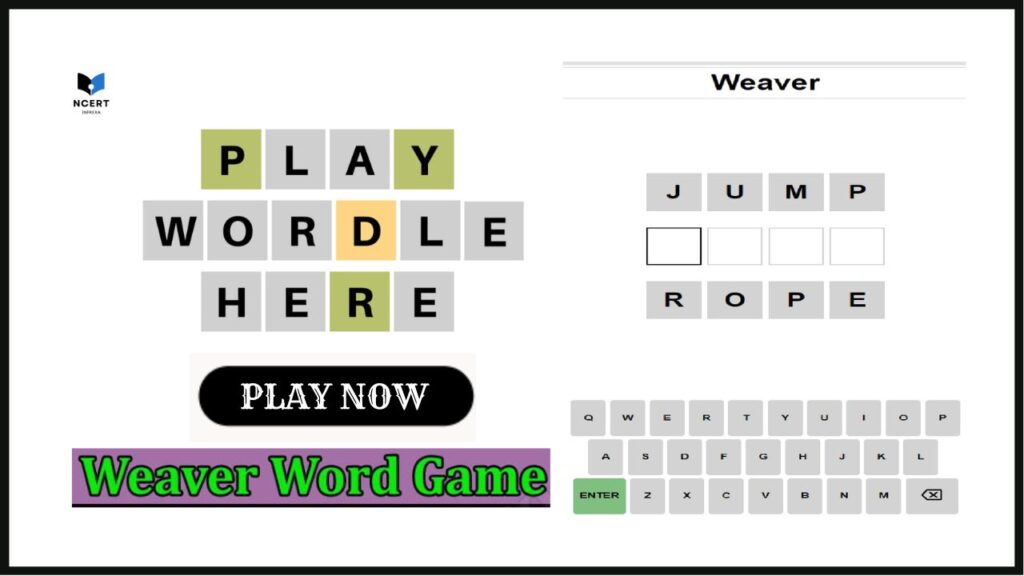
When I first discovered Weaver, I thought it was simple, just a game of forming random words. But the challenge – the Word Ladder – was invented by Lewis Carroll back in 1879, and it’s a brilliant exercise in logic. It’s not about vocabulary; it’s about finding the single, shortest, and most efficient path between two points.
The true breakthrough in this game comes when you realize the path is not always straight. I remember being stuck trying to get from COLD to WARM, obsessively fixing the first letter. The real trick was sacrificing one of the already-correct letters to open up a better route. That moment – that willingness to move away from the goal to eventually get closer – is when the game clicked for me.
Rules: One Letter, Six Tries
In the game, you start with a given word (like FAST) and must reach a target word (like SLOW) by changing only one letter at a time. Every step you take must form a valid English word.
Most daily challenges give you 6 tries or fewer to complete the ladder, usually with 4-letter words. (Some practice modes may offer 5-letter variants, but the strategy is the same).
When you enter a new word, the letters that match the final target word in the correct position turn Green. Your job is to fill the whole ladder with green letters as fast as possible.
The Strategy: The Middle Target Method
Most beginners try to solve the words sequentially, fixing the first letter, then the second. This is slow and leads to dead ends. A strategic player focuses on the middle because the middle two letters often create the biggest constraints.
1. Analyze the Ends
Look at the starting word and the target word. Which letters are the same? Focus on the letters that are different. Example: FAST to SLOW. Only the S is the same in position 4. You need to change F, A, T, and L, O, W.
2. Hit the Middle First
Your primary goal in the first 2-3 moves should be to get the inner two letters ($A$ and $T$ in FAST) as close to the target’s inner letters ($L$ and $O$ in SLOW) as possible.
Why? If you lock in the first letter, you might trap yourself into a word family that can’t transition to the required third letter. By focusing on the center, you keep the beginning and end flexible.
A great second move, for example, might be changing FAST to CAST (fixes the S, changes F to C). The next move might be COST (fixes the T, changes A to O). Now you are only worried about the first letter.
3. Vowels and Consonant Blocks
Change vowels ($A, E, I, O, U$) quickly, as they are usually the most flexible. Be cautious with changing consonants in the third or fourth position, as that often requires a dedicated word-change move to unlock.
4. Prioritize the Final Link
Once you are within two moves of the target, you often have to make a guess that looks completely wrong but sets up the final sequence. Don’t be afraid to change a green letter back to gray if it creates a better path to the final word. The goal is the solution in six moves, not having four green letters by the third move.
Playing Weaver is less about finding a common word and more about seeing the bridge – the single, functional word that exists only to get you from point A to point B. If you focus on the flexible path, you’ll find you can solve puzzles much faster.
Alternatives
If you enjoy this single-change word puzzle, you might also like Wordle (single-word deduction) or Nerdle (the math equation version).
You can easily find the game by searching for “Weaver game” or “word ladder puzzle” online. Many platforms, including those focused on daily word challenges, offer the game for free.